


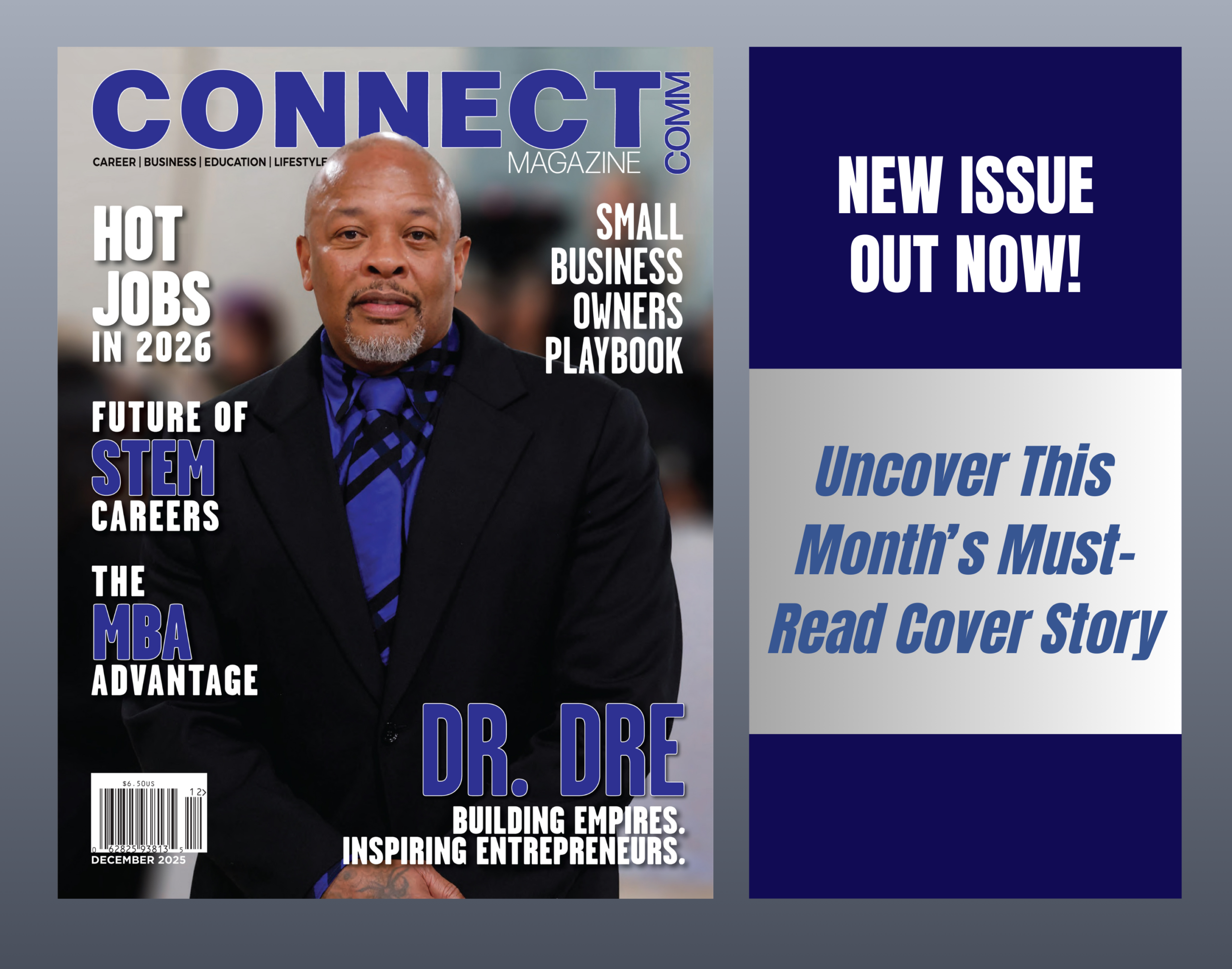
Andre Romelle Young—better known as Dr. Dre—is a name etched permanently into the soundscape of American culture. The Compton-born producer, rapper and entrepreneur helped define West Coast hip-hop, launched the careers of household names like Snoop Dogg, Eminem and Kendrick Lamar, and revolutionized audio technology through Beats by Dre. Yet for all the platinum records and billion-dollar business deals, Dre’s most enduring influence may not come from the music charts at all. In recent years, he has steadily transformed his fame and fortune into platforms for education, opportunity and empowerment—particularly for young people and Black-owned businesses.
VIEW THE DIGITAL MAGAZINE FOR THIS AND MORE STORIES IN THE ISSUE OUT NOW!
From Compton to the World
Born in 1965, Dre grew up in Compton, California —a city often associated with limited resources and high crime rates. His early exposure to music came through his stepfather’s record collection, which sparked his love for funk and soul. As a teenager, he joined the World Class Wreckin’ Cru, co-founded N.W.A. in the late 1980s. That group’s unflinching depiction of inner-city realities propelled hip-hop into the national conversation—and made Dre both a pioneer and a lightning rod.

CLEVELAND, OHIO – OCTOBER 30: (L-R) Eminem, Dr. Dre, LL Cool J, and Jennifer Lopez pose backstage during the 36th Annual Rock & Roll Hall Of Fame Induction Ceremony at Rocket Mortgage Fieldhouse on October 30, 2021 in Cleveland, Ohio. (Photo by Kevin Mazur/Getty Images for The Rock and Roll Hall of Fame )
His 1992 solo album The Chronic introduced the world to G-funk, while Aftermath Entertainment became a launching pad for some of rap’s most iconic voices. Then came Beats Electronics, co-founded with Jimmy Iovine, which Apple purchased in 2014 for $3 billion. Dre’s personal fortune soared, but so did his sense of responsibility. As he has often reflected, the wealth and fame were only meaningful if he could redirect them toward opportunities he never had growing up.
Building Futures at USC
That belief crystallized in 2013, when Dre and Iovine donated $70 million to the University of Southern California. Their gift established the Jimmy Iovine and Andre Young Academy for Arts, Technology and the Business of Innovation, a school that combines design, entrepreneurship, technology and the arts.

LOS ANGELES, CALIFORNIA – OCTOBER 02: (L-R) Erica Muhl, Andre Young aka Dr. Dre, Jimmy Iovine and Carol L. Folt attend the dedication ceremony at USC Iovine and Young Hall on October 02, 2019 in Los Angeles, California. (Photo by Robin L Marshall/Getty Images)
Unlike traditional music or business programs, the Academy focuses on cross-disciplinary education, preparing students to move fluidly between creative and corporate spaces. Undergraduates work in tracks such as product design, digital media, venture management and communication strategy—skills that reflect the real demands of today’s innovation economy. In 2022, USC expanded the concept further, opening the Iovine and Young Hall, a state-of-the-art facility that now also hosts a master’s program in integrated design, business and technology.
For Dre, the Academy is about giving students the tools he never had access to. “I didn’t have an outlet for my ideas, and I didn’t understand business,” he has said in past remarks. The Academy now provides that outlet for hundreds of students every year, producing graduates who have gone on to launch startups, develop innovative technologies and enter leadership roles across various industries.
COMPTON, CA – MAY 22: Andre “Dr. Dre” Young donated $10 million for the construction of the school’s Andre “Dr. Dre” Young Performing Arts Center in the background. He attended the ribbon cutting for the new campus on Thursday, May 22, 2025 in Compton, CA. (Myung J. Chun / Los Angeles Times via Getty Images).
Performing Arts Center
While the USC Academy serves a global population, Dre has never lost sight of his roots. In 2017, he pledged $10 million to fund a new performing arts center at Compton High School. When the $200 million campus broke ground in 2022, his gift stood out as both personal and symbolic.
Opened this year, the Andre “Dr. Dre” Young Performing Arts Center has a 900-seat theater, digital media production facilities and rehearsal spaces—resources rarely available in underserved communities. For students, it promises not just a venue, but a platform for expression, confidence and career exploration. For the wider community, it represents a point of pride and a source of possibility.
At the groundbreaking, Dre reflected on his own teenage years: “I was an artistic kid in school with no outlet for it…with nothing to support my gift…schools left me feeling unseen.” His donation ensures today’s Compton students won’t face the same void. By investing in infrastructure, Dre is helping transform the narrative of what young people in his hometown can achieve.

INGLEWOOD, CALIFORNIA – FEBRUARY 13: (L-R) Dr. Dre and Snoop Dogg perform during the Pepsi Super Bowl LVI Halftime Show at SoFi Stadium on February 13, 2022 in Inglewood, California. (Photo by Rob Carr/Getty Images)
Black-Owned Businesses
In recent years, Dre has also turned his attention to economic equity. Among his most notable efforts is his investment in Prosperity Market, a Black women-owned mobile farmers market founded in Los Angeles. The initiative, created by entrepreneurs Carmen Dianne and Kara Still, delivers fresh produce and goods from Black-owned brands across neighborhoods from Malibu to Compton. With Dre’s backing, Prosperity Market is developing solar-powered mobile trailers that will serve as traveling farmers markets and kitchens, expanding access to healthy food while also highlighting Black entrepreneurs.
The project does more than address food insecurity—it creates ecosystems of economic opportunity. By purchasing from and promoting Black-owned farms, chefs and small businesses, Prosperity Market ensures that money circulates within underrepresented communities. Dre’s support underscores his recognition that sustainable change isn’t just about education, but also about creating markets where talent and creativity can thrive.
This investment also has a global reach. Through Prosperity Market’s fiscal sponsor, SIMA Studios, Dre’s contribution will help support entrepreneurship training for thousands of African women across 48 countries in partnership with LEAP Africa. The alignment between local empowerment and global opportunity reflects Dre’s expanding philanthropic vision.

LOS ANGELES, CALIFORNIA – SEPTEMBER 04: (L-R) Dr. Dre and Benny Blanco attend the Flipper’s Fall/Winter 2025 Collection Debut & Launch Party on September 04, 2025 in Los Angeles, California. (Photo by Kevin Mazur/Kevin Mazur/Getty Images for Flipper’s)
A Broader Philosophy
Dre’s approach to philanthropy differs from one-off donations or temporary campaigns. By investing in institutions—such as universities, schools and mobile markets—he is creating structures designed to endure beyond his involvement. His choices also reflect the gaps he personally felt: lack of formal education in business, limited arts infrastructure in Compton and systemic barriers facing Black entrepreneurs.
That personal resonance adds weight to his giving. As he admitted in a Fox 11 interview, had he understood the business side of the music industry earlier, he could have “saved a lot of time, money and friendships.” The USC Academy directly addresses that knowledge gap for the next generation. Similarly, the Compton High School arts center fills the void that Dre once felt as a creative teenager without resources. And Prosperity Market pushes back against barriers Black businesses still face today.
Beyond Beats
Dr. Dre’s legacy in hip-hop and business is secure, but his emerging legacy as a philanthropist is just beginning to take shape. From nurturing innovation at USC to opening doors in Compton and creating markets for Black entrepreneurs, Dre is proving that success is most powerful when shared.
In a cultural moment where inequality remains a pressing issue, Dre’s story offers a blueprint: leverage fame to build institutions, invest in communities you come from and leave structures in place that will outlive you. As he has put it, the goal is to give young people “the kind of tools and learning they deserve.”
For an artist who once chronicled the struggles of his city through raw beats and uncompromising lyrics, Dre’s latest verses are written not in rhyme but in real-world change. His music may have shaped generations, but his philanthropy is shaping the future.
Read more articles for the ConnectComm Community here.