


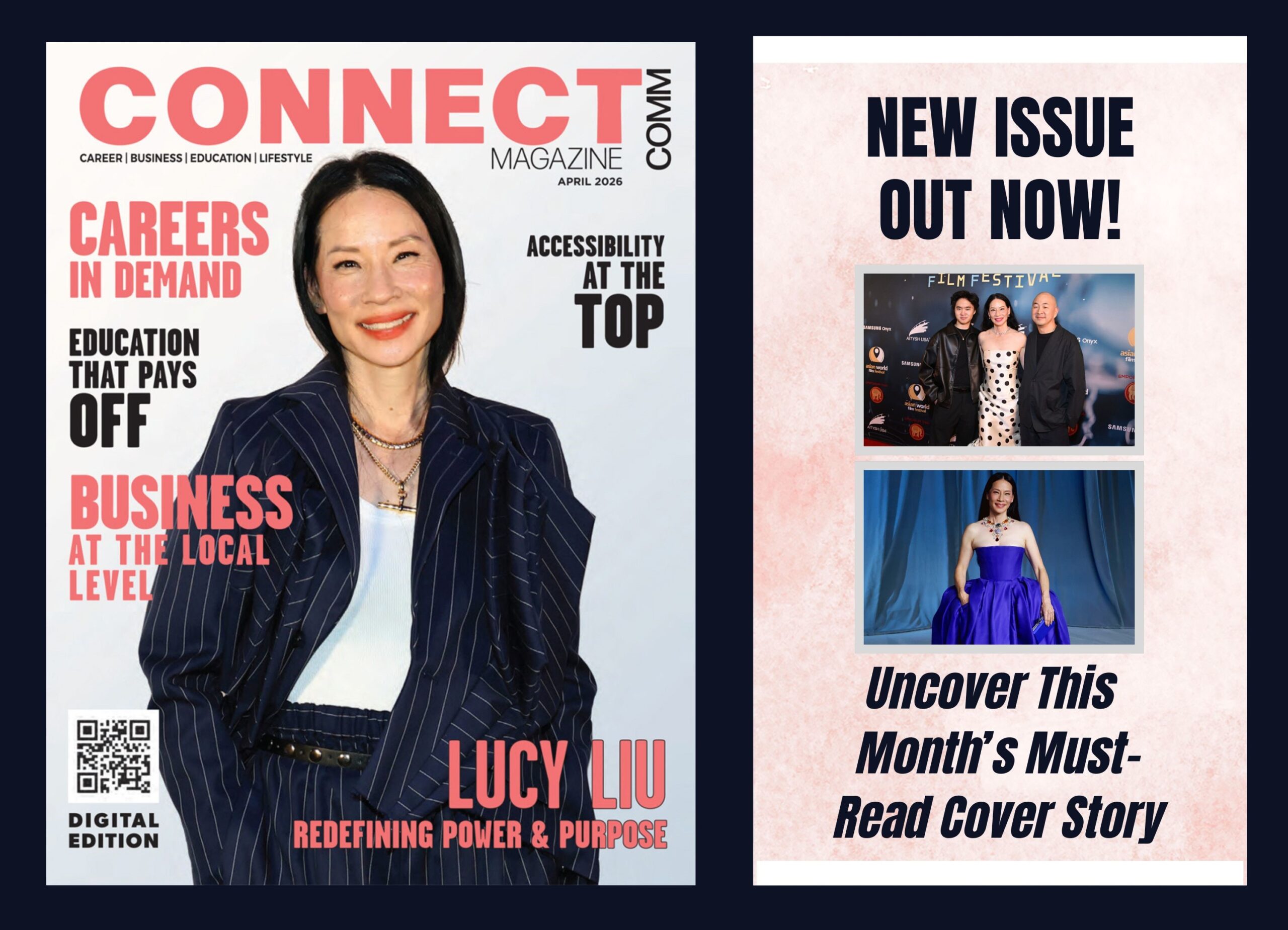
Lucy Liu didn’t arrive in Hollywood by accident. For nearly three decades, she has built a career that defies easy categorization, emerging not only as a versatile performer on screen but as a committed global advocate whose influence extends far beyond entertainment.
Born in Queens, New York, on Dec. 2, 1968, Lucy Alexis Liu began her acting career in the early 1990s. Eventually, she earned wide recognition for her breakout role as Ling Woo on the television series Ally McBeal (1998-2002). Ally McBeal marked a turning point: Liu became one of the first Asian-American women to hold a prominent role in a mainstream TV series at a time when such visibility was rare. She went on to star in major films, including Charlie’s Angels, Kill Bill and Chicago, roles that helped redefine what leading women could look like in Hollywood. Over the course of her career, she has earned two Critics’ Choice Awards, two Screen Actors Guild Awards and nominations for two Primetime Emmy Awards. In 2019, she became only the second Asian-American woman to receive a star on the Hollywood Walk of Fame.

LOS ANGELES, CALIFORNIA – OCTOBER 18: Lucy Liu attends the 2025 Academy Museum Gala at Academy Museum of Motion Pictures on October 18, 2025 in Los Angeles, California. (Photo by Taylor Hill/FilmMagic)
Yet Liu’s legacy is not defined solely by her artistic accomplishments. Long before her fame blossomed internationally, she made a conscious decision to harness that visibility for humanitarian causes. In 2004, she accepted an invitation to serve as an ambassador for the U.S. Fund for UNICEF, the United Nations Children’s Fund tasked with protecting the world’s most vulnerable children. That appointment marked the beginning of a sustained and often personal commitment to advocacy.
Global Advocacy
As a UNICEF ambassador, Liu has traveled extensively, visiting countries including Pakistan, Russia, Peru, Egypt, the Democratic Republic of the Congo, Côte d’Ivoire, Lesotho and Lebanon. On these missions, she has observed firsthand the profound impacts of poverty, conflict and disease on children and families, particularly in regions struggling to access basic resources such as safe water, health care and education.
Her longtime involvement has repeatedly centered on amplifying the voices of people often excluded from global conversations. Liu has engaged with local communities, met with children directly, and, in some cases, testified on UNICEF’s behalf at significant international forums. As part of UNICEF’s Tap Project, which raised funds to provide clean drinking water, she has served as a national spokesperson, raising awareness of a fundamental human need that still eludes millions worldwide. CULVER CITY, CALIFORNIA – NOVEMBER 15: (L-R) Actors Lawrence Shou and Lucy Liu and director Eric Lin attends a screening of “Rosemead” during the 11th Asian World Film Festival at Culver Theater on November 15, 2025 in Culver City, California. (Photo by Michael Tullberg/Getty Images)
In 2022, Liu helped draw global attention to UNICEF’s broader mission by serving as executive producer of the documentary If You Have, which chronicled 75 years of the organization’s history. The film places individual stories of resilience and struggle alongside the structural challenges governments and aid organizations face in improving children’s lives worldwide.
Anti-Trafficking Work
Liu’s advocacy work also tackles darker, deeply entrenched global problems, including human trafficking. She has collaborated with organizations such as Apne Aap Women Worldwide, a nonprofit focused on ending gender-based exploitation and empowering survivors of trafficking and prostitution.
Her film work illustrates a willingness to use media for social impact. Liu produced and narrated Redlight (2009), a documentary on human trafficking in Cambodia, incorporating footage from brothels where children were unlawfully exploited. The film premiered at the Woodstock Film Festival and subsequently aired on Showtime, bringing the issue to broader public attention.
In 2014, she made her directorial debut with Meena, a short documentary about sex trafficking in India, based on the true story of a girl forced into slavery at a young age. The film was conceived in part as a narrative adaptation of the opening chapter of Half the Sky, a widely read book on women’s oppression and empowerment.
These projects are more than artistic ventures—they are tools of advocacy. By confronting audiences with unvarnished truths about exploitation and inequality, Liu has helped draw sustained attention to issues that many policymakers and ordinary citizens might otherwise overlook.LOCARNO, SWITZERLAND – AUGUST 14: Joseph Krings, Lucy Liu, Eric Lin and Lawrence Shou attend the ‘Rosemead’ photocall during the 78th Locarno Film Festival on August 14, 2025 in Locarno, Switzerland. (Photo by Alessandro Levati/Getty Images)
Creative Advocacy
Advocacy for Liu extends beyond film and international travel; it includes using her personal creative talents. She is an accomplished visual artist and photographer, fields that she has integrated into her humanitarian work. In the past, she exhibited artwork to raise money for UNICEF and published a book of her art, with proceeds benefiting children’s programs.
Liu has consistently supported education and equality as foundational to human development. She backs initiatives including the Clinton Foundation and the Human Rights Campaign, lending both her voice and her image to efforts that promote human rights globally.
Gender equality remains a central theme in her advocacy. In 2020, she joined the Johnnie Walker “First Women” campaign, which spotlights women who have achieved groundbreaking accomplishments in their fields and underscores the importance of equal representation. Through this initiative, Liu helped highlight the challenges and achievements of women across sectors, reinforcing her belief in the power of visibility as a catalyst for change.
Recent Honors
Recognition for Liu’s activism has matched her achievements in entertainment. Her humanitarian work has earned honors such as the Danny Kaye Humanitarian Award—given to individuals whose sustained commitment helps improve children’s lives—and the Women’s World Award for her dedicated philanthropic impact.
Her influence continues into 2025. Liu was named keynote speaker for the annual New Friends New Life luncheon in September 2025, an event focused on combating human trafficking and empowering survivors. The Dallas-based organization enlisted her to share her insights and rally support for its work, showcasing her role as a public voice for human rights and social justice.
In May 2025, The Asian American Foundation (TAAF) also honored Liu at its annual awards dinner in New York City. The Asian American Foundation, a national nonprofit dedicated to advancing advocacy and representation for Asian American and Pacific Islander communities, recognized her contributions both within and beyond entertainment. Liu accepted the award alongside peers who similarly influence culture and policy. Dwayne Johnson, Lucy Liu, Chris Evans at the premiere of Amazon MGM Studios’ “Red One” held at Alice Tully Hall on November 11, 2024 in New York, New York. (Photo by John Nacion/Variety via Getty Images)
Enduring Legacy
Liu’s story is not one of simple celebrity. Her career mirrors an evolution in American culture’s understanding of representation, identity and voice. As one of the few Asian-American women to break through Hollywood’s historically narrow casting barriers, she has helped widen the lens through which audiences see not just Asian characters, but Asian stories.
Her advocacy reflects a conviction shared by only a subset of public figures—that fame brings responsibility. She has leveraged her status to confront issues ranging from access to clean water to sexual exploitation, bringing often obscured problems into the public eye. In doing so, she has harnessed the very power that made her a global figure to uplift those who otherwise might never be heard.
As Hollywood and society continue to grapple with questions of equity and inclusion, Liu’s journey offers a model of how cultural influence can be wielded for collective good. By blending artistry with activism, she demonstrates that impact is not measured by box-office totals or awards alone, but by the countless lives touched by awareness, advocacy and genuine engagement.
Read more articles for the ConnectComm Community here.